Not all conversion drops are performance issues: understanding mix rate effect
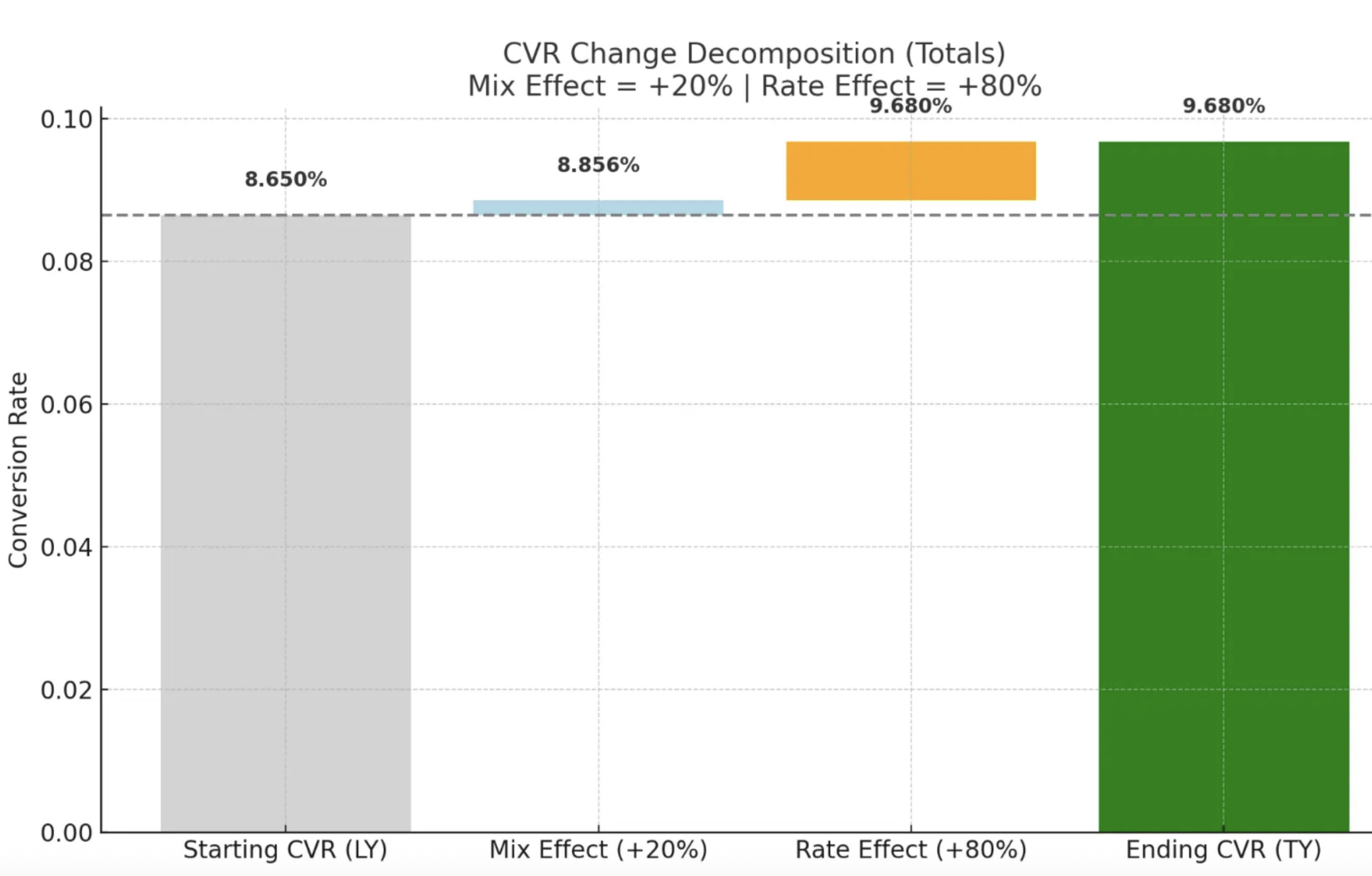
When a business notices a decline in conversion rate (CVR), the immediate instinct is often to assume that something is wrong with the website, campaign effectiveness, or customer intent. While these are valid hypotheses, analysts frequently overlook one of the most common and impactful drivers of CVR changes: the mix rate effect.
What is the mix rate effect?
The mix rate effect refers to changes in overall conversion rates that are driven not by performance shifts within individual channels or segments, but by changes in the proportion of traffic each channel contributes.
In simple terms: the mix effect is when your traffic shifts toward channels that usually convert better, whereas the rate effect is when shoppers become more likely to convert within each channel.
If the mix effect is high -- meaning a greater percentage of total users are coming from channels with strong CVR -- it suggests your traffic is skewed toward higher-performing sources. You are not just getting more intent-driven users overall, you are drawing more of your total traffic from channels that typically produce shoppers who are more likely to convert.
If the rate effect is high, it suggests that even if the total number of shoppers drops or shifts across channels, visitors are overall more likely to transact or show strong buying signals. Your site is attracting users who are better qualified, more ready to buy, or motivated by relevant marketing and search strategies.
For example:
- SEO may bring in millions of visitors with a relatively low CVR.
- SEM may bring in fewer visitors but at a much higher CVR.
- If the share of SEO traffic grows relative to SEM traffic, the overall CVR can drop -- even if each channel's performance remained stable or even improved.
This is why looking only at the headline conversion rate can be deeply misleading.
How is mix/rate effect calculated?
The formulas are straightforward once you understand what each term represents:
- Mix Effect = Mix % TY × LY CVR Rate -- what if this year's mix applies to last year's CVR rates
- Rate Effect = Mix % LY × TY CVR Rate -- what if last year's mix applies to this year's CVR rates
- Mix Effect Contribution = Mix Effect − WTD Rate LY
- Rate Effect Contribution = Rate Effect − WTD Rate LY
- WTD Rate LY = Mix % LY × LY CVR Rate
- Mix % LY = Traffic ÷ Total Traffic
- LY CVR Rate = Product Detail Page CVR ÷ Traffic
Why this matters in real business cases
Say you are reviewing data for the week of June 1st, 2025 versus last year, and you see:
- SEO traffic decreased sharply with a modest CVR improvement, and its share of total traffic increased more aggressively year over year.
- SEM traffic also dropped, but its share of total traffic increased more modestly, with an increase in CVR.
Even though both SEO and SEM saw CVR improvements individually, the overall mix shifted more heavily toward SEO -- which naturally carries a lower conversion rate than SEM.
The result: headline CVR appears to drop or stagnate. But in reality, this is not because performance got worse -- it is because traffic mix leaned toward lower-CVR channels.
Why analytics teams must pay attention
Failing to separate rate effect (true performance shifts) from mix effect (distribution changes) can lead to serious misdiagnosis:
- Incorrect conclusions: Teams may assume campaigns are underperforming when the actual issue is traffic composition.
- Misguided actions: Marketing may overreact by cutting budgets or changing creatives, instead of focusing on optimizing channel balance.
- Missed opportunities: Growth from lower-CVR channels like SEO may be highly valuable in terms of reach, even if it dilutes overall CVR.
Best practices for conversion analysis
Decompose CVR changes into two components: mix effect (change caused by traffic distribution shifts) and rate effect (change caused by actual performance differences within channels).
Use weighted averages to track how each channel's mix contributes to overall CVR. Contextualize declines -- a falling blended CVR is not necessarily bad if it comes from increased traffic in channels that scale affordably such as SEO.
Instead of saying "conversions dropped," say: "Overall CVR declined by 0.5 points. 70% of this drop is due to mix shift (more SEO traffic), while only 30% is due to performance changes within channels." This distinction helps leadership make better strategic decisions.
In summary -- any time conversions drop, analytics teams must check whether the cause is truly performance-driven or just a by-product of traffic mix. Ignoring the mix rate effect risks chasing the wrong problems and missing the real story behind the numbers.
Mix Effect = Mix % TY × LY CVR Rate · Rate Effect = Mix % LY × TY CVR Rate
Appendix: four scenarios to diagnose
Consider a product detail page where traffic is trending down. Is it a mix issue (less high-intent customers coming to the site) or a rate issue (good traffic coming but fewer moving toward checkout)? Mix/rate analysis will surface one of four scenarios:
- Scenario 1: Mix shift away from high-converting channels, but rate is positive -- we are getting high-intent traffic despite the shift.
- Scenario 2: Mix shift away from high-converting channels, and rate is negative -- we are getting low-intent traffic.
- Scenario 3: No mix shift, rate is positive -- status quo, no meaningful changes.
- Scenario 4: No mix shift, rate is negative -- we are bringing in low-quality traffic regardless of channel.
More articles