Measuring SEM effectiveness: Part 1 -- attribution & incrementality
An online travel platform invests $100M in SEM. The overall goal of SEM is to increase visibility in search engines by achieving higher rankings in organic search results or top positions for ad placements. The questions are: which SEM and SEO strategies drive real incremental traffic? How do we optimize spend for maximum impact? Where should we invest the next $100M?
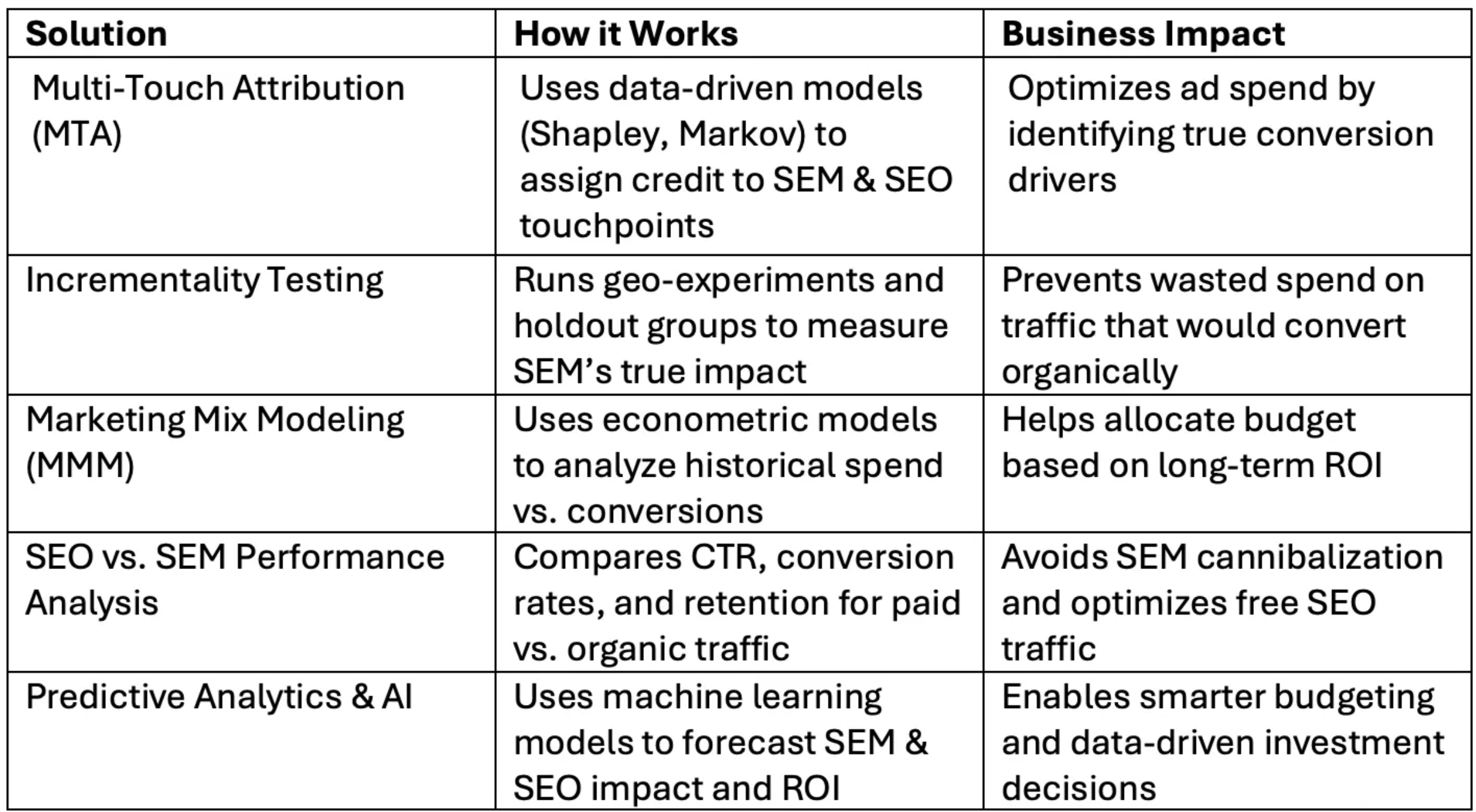
To answer these we will use a mix of attribution, experimentation, and advanced analytics.
Multi-touch attribution · Incrementality testing · Marketing mix modeling · SEO vs SEM analysis · Predictive analytics & AI
1. Multi-touch attribution: who gets credit?
Example: a user searches "Best Hotels in Paris" and clicks on an SEM ad, then returns via an organic search before booking. Which channel should get credit? This helps optimize ad spend by identifying which SEM keywords or SEO content are actually driving conversions.
How to approach it:
- Use data-driven attribution models such as Shapley or Markov chains to assign value based on how each touchpoint contributes to the conversion
- Compare results with rule-based models like first-click or last-click to see if budget is being misallocated
2. Incrementality testing: what is the true impact?
Example: the travel platform spends $10M on SEM for "New York Hotels." But if we turned off ads, how much of that traffic would still come from organic search? This prevents wasted ad spend on traffic that would have converted organically anyway.
How to approach it:
- Run geo-experiments: pause SEM spend in certain regions and compare traffic and bookings with regions still running ads
- Use holdout groups: show SEM ads to one group and suppress them for another to measure true incremental lift
3. Marketing mix modeling: where should we invest?
Example: the travel platform sees fluctuating traffic from SEM and SEO. How do we know if seasonality, competitor activity, or external factors such as travel demand are affecting performance? This helps leadership decide whether to shift more budget into SEO or SEM based on long-term ROI.
How to approach it:
- Use econometric models to analyze historical spend versus traffic and conversions
- Separate SEM and SEO impact from seasonality, competitor spend, and macroeconomic factors
4. SEO vs. SEM performance: organic vs. paid efficiency
Example: the travel platform ranks number one organically for "Best Beach Resorts" but also runs SEM ads for the same keyword. Are we paying for clicks we would get for free? This helps avoid cannibalization where SEM budgets are wasted on clicks that SEO could capture at no cost.
How to approach it:
- Compare CTR, conversion rates, and customer retention between SEM and SEO
- A/B test turning off paid ads for high-ranking organic terms and measure the drop-off
5. Predictive analytics and AI: smarter budgeting
Example: if the travel platform increases SEM spend by 20% next quarter, how much incremental revenue will it generate? This provides data-driven budget recommendations for future quarters.
How to approach it:
- Use machine learning models trained on historical data to predict traffic, conversions, and ROI
- Implement causal inference techniques to isolate SEM's real contribution from external factors
Key business impact metrics
This approach helps articulate the why behind these four critical metrics:
- Revenue from SEM & SEO -- how much revenue is driven by each channel?
- Return on Ad Spend (ROAS) -- is paid search profitable?
- Incremental lift via geo-experiments -- what percentage of paid search conversions are truly incremental?
- Organic vs. paid traffic share -- are we overly dependent on SEM when SEO could drive more free traffic?
The platforms that answer these questions with rigor will allocate the next $100M far more effectively than those relying on last-click attribution and gut feel.